
Last updated November 15, 2026
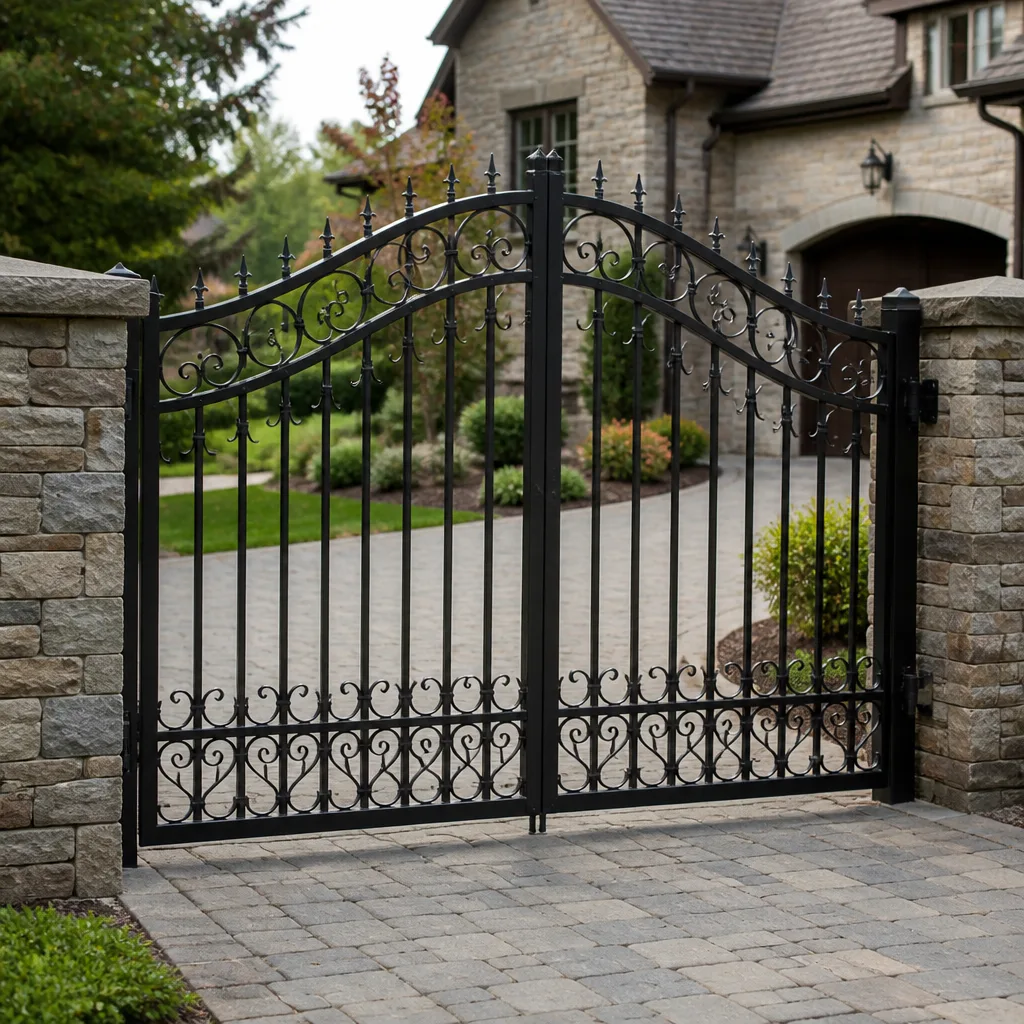 Wrought iron
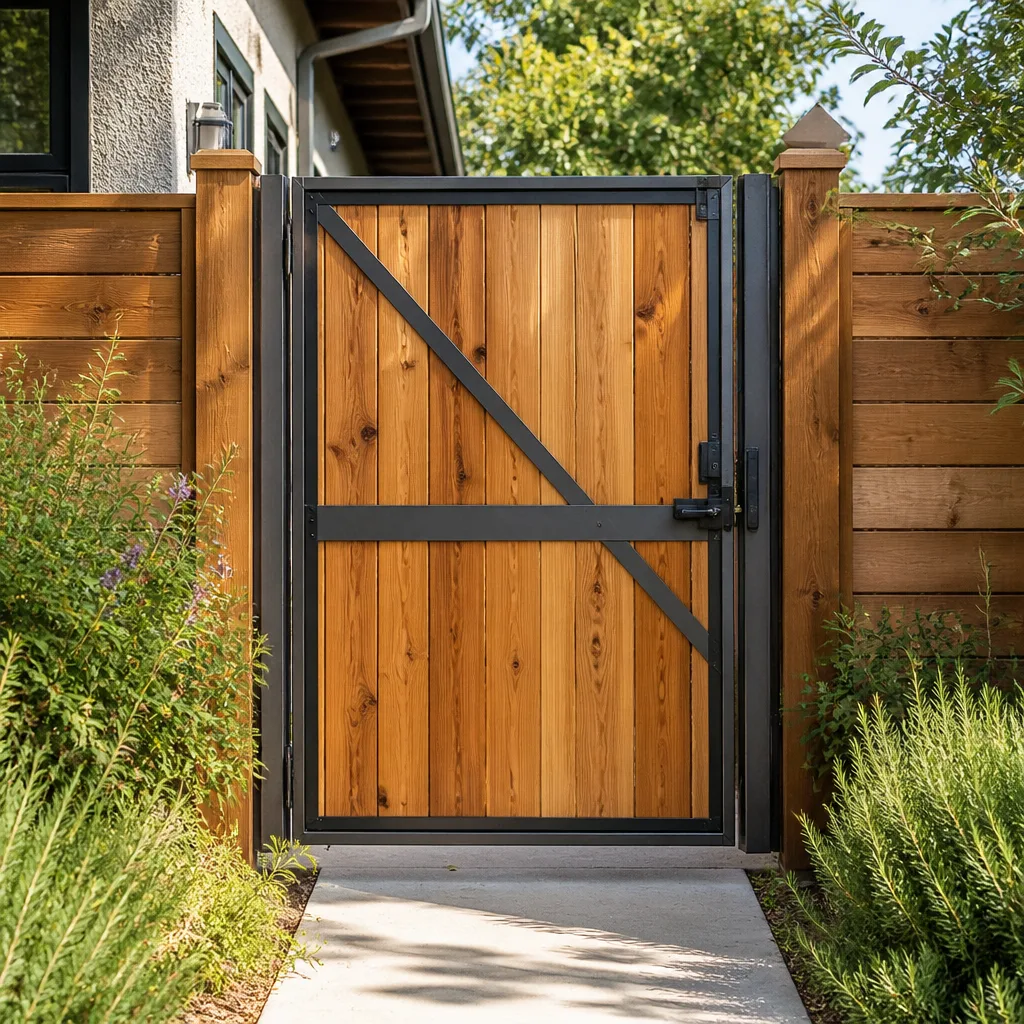 Wood & steel frame
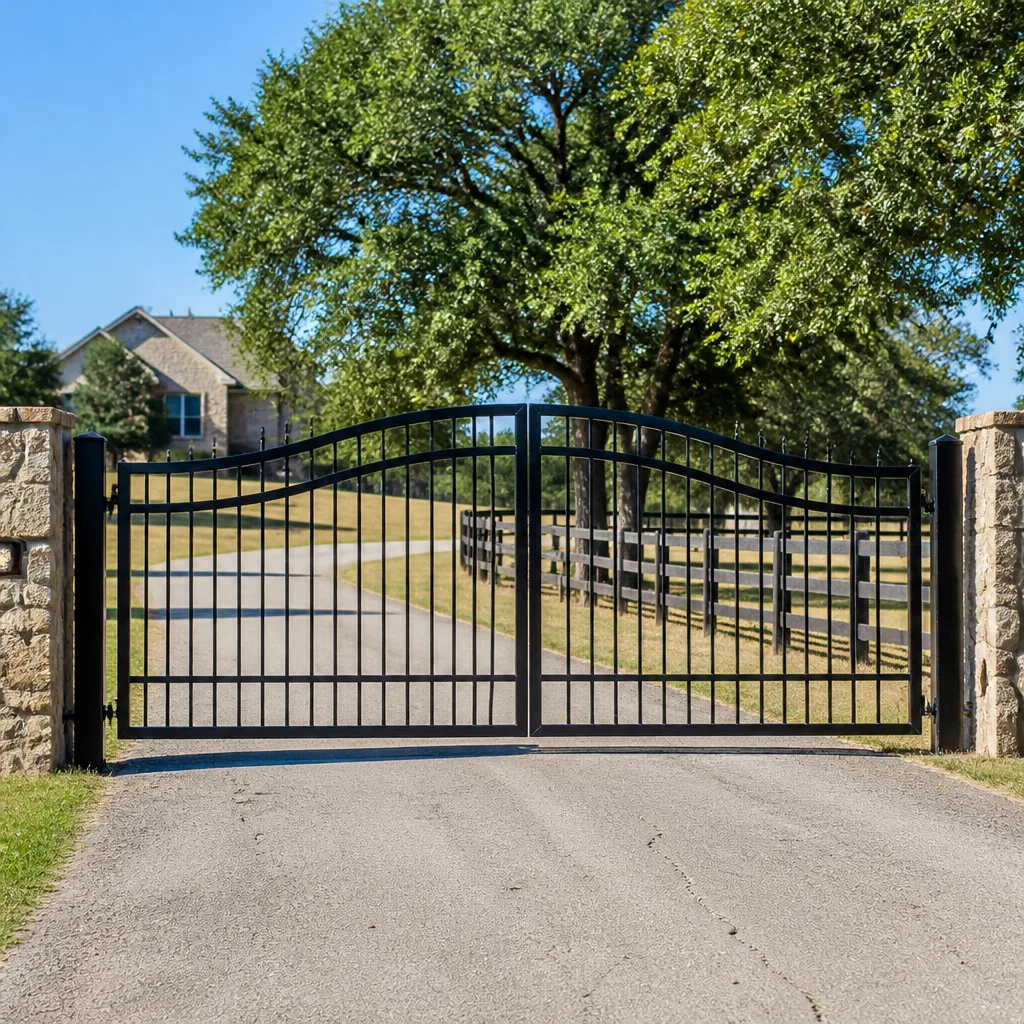 Farm & ranch
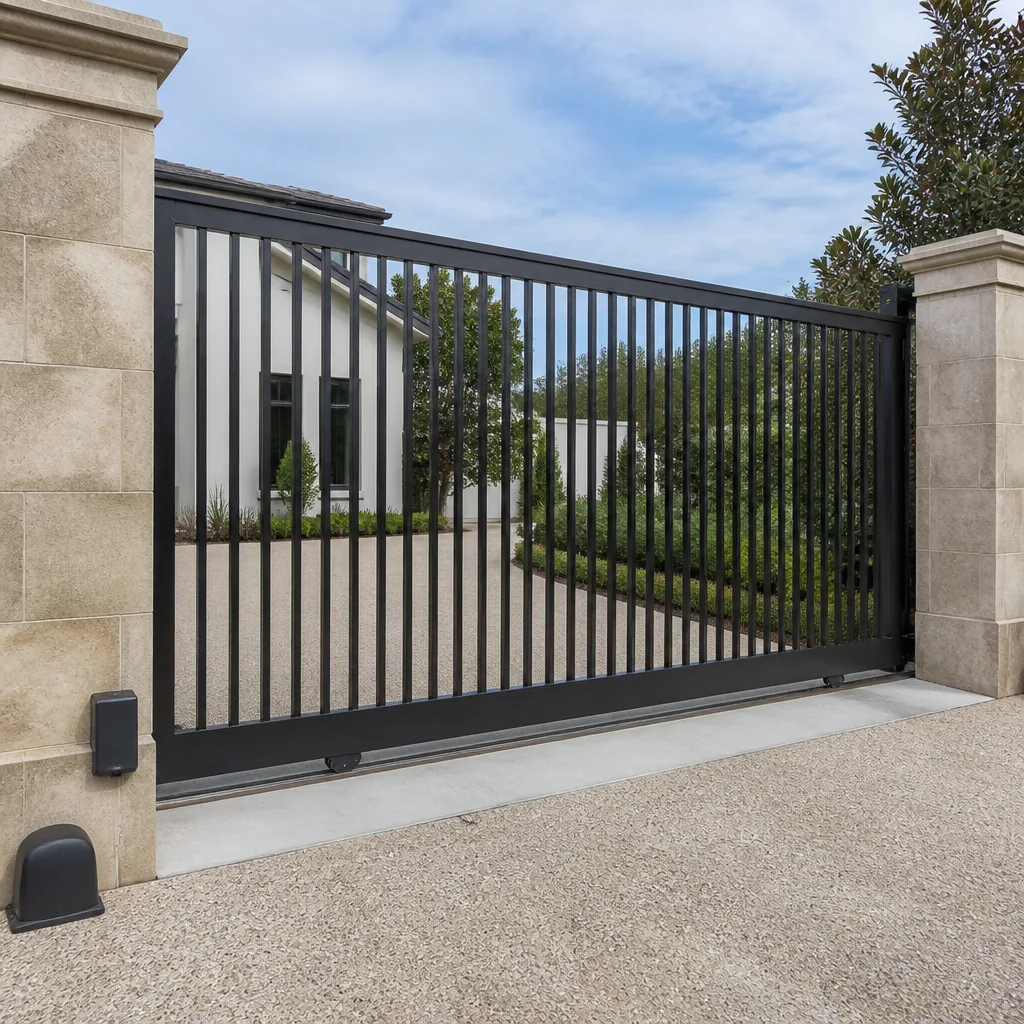 Sliding driveway gates
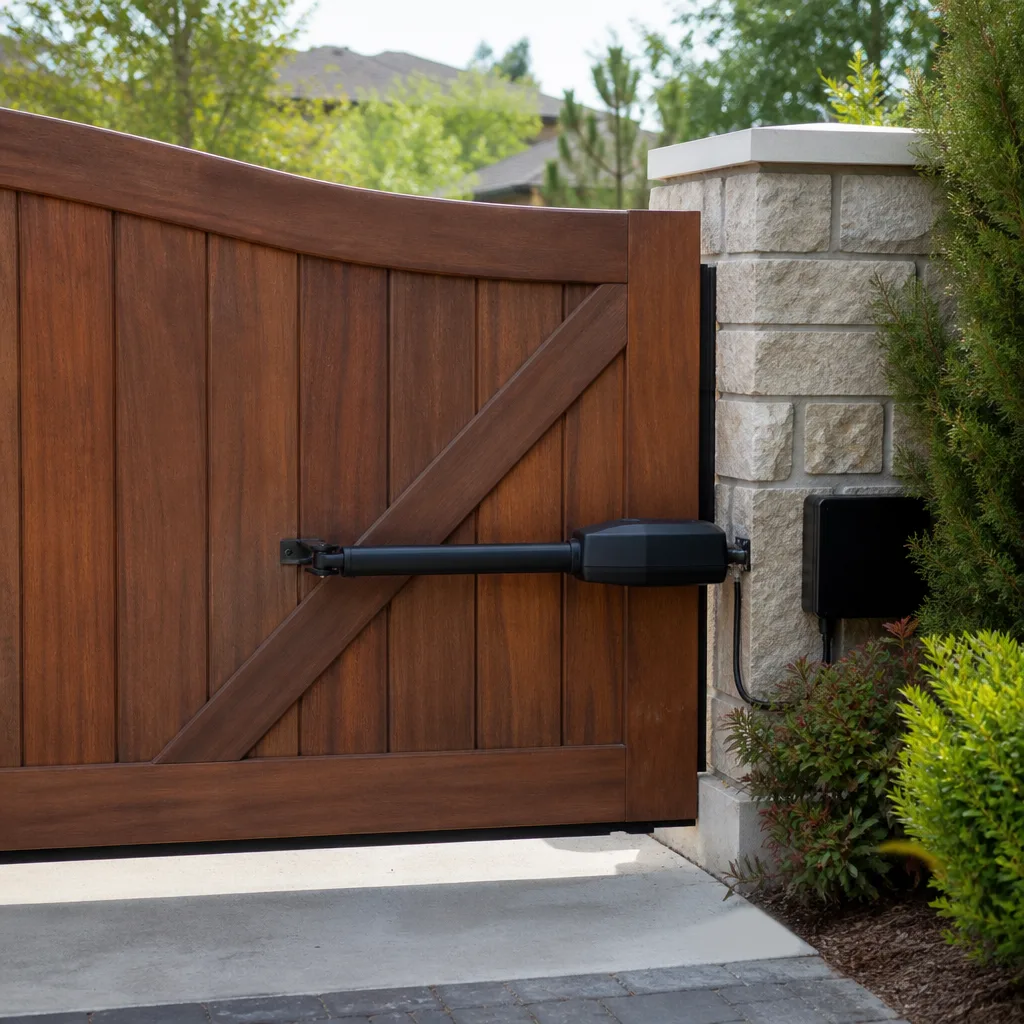 LiftMaster operators
Free on-site gate assessment - hinges, posts, and your LiftMaster or Nice gate operator checked before anything is quoted
The assessment is free and the quote is the invoice.
Get your free estimateGate Repair Cost Breakdown: The Pembroke Pines Homeowner’s Reference for 2026
The most telling number on a gate repair quote often isn’t the total – it’s the diagnostic line. Contractors who advertise a waived or free diagnostic typically recover that time somewhere else: in parts markup, in a bundled labor rate, or in a scope written wide enough to absorb it. That single line tells you how the rest of the quote was built. The same failed operator or dragging slide gate can be scoped three different ways by three different companies, and the spread can reach triple digits in either direction. In this guide we walk through the actual cost structure behind gate repair in Pembroke Pines – mechanical, electrical, operator-level, and replacement – so you can read a quote and know what’s driving the number instead of guessing.
Quick Answer
Gate repair in Pembroke Pines typically runs $150 to $180 for a basic mechanical fix like a hinge, roller, or alignment adjustment, $250 to $650 for electrical work involving sensors, wiring, or a control board, and $400 to $900 for operator-level repairs like a motor or gearbox. A full gate and operator replacement on a residential property generally runs $3,200 to $8,500 depending on gate size, operator class, and site conditions. The written estimate sets the final price, and the estimate itself is free.
Styles & brands we work with
- Wrought iron
- Wood & steel frame
- Farm & ranch
- Sliding driveway gates
- LiftMaster operators
Table of Contents
- What do mechanical gate repairs cost in Pembroke Pines?
- How much does electric gate repair cost in Pembroke Pines?
- What does operator-level repair cost – motor, gearbox, and control board?
- How do parts markup practices affect a gate repair quote?
- Why does the same repair cost more on some Pembroke Pines properties?
- When does repair-vs-replace actually favor replacement?
- What do HOA and shared-gate invoices need to include?
- What drives labor rates for gate work in Pembroke Pines in 2026?
What do mechanical gate repairs cost in Pembroke Pines?
Mechanical repairs are the most straightforward category and the easiest to price transparently. Basic mechanical gate repair in Pembroke Pines typically runs $150 to $180, moving up toward $400 to $500 when the job involves a heavy panel, a complete roller and track replacement on a slide gate, or realignment work on a gate that’s been dragging for months.
What counts as mechanical:
- Hinges on swing gates – worn or seized hinges that let the panel sag. On a double swing gate, hinges are often the only reason a gate stops latching cleanly.
- Rollers and tracks on slide gates – a roller fails, the gate drops, and every cycle grinds the track a little more. Replacement is usually quick; fixing the track afterward is where the cost climbs.
- Latch and strike alignment – the gate closes but doesn’t catch, or catches with a shove. Usually an adjustment, occasionally a hardware replacement.
- Panel and post hardware – brackets, stops, and the mounting hardware that holds the leaf in place.
The mechanical category has the widest gap between “needs an adjustment” and “needs the whole track rebuilt.” A technician who diagnoses the second case when the first would do is charging more than the job requires. That’s why an on-site inspection before a written quote matters more here than anywhere else on this list. Mechanical work also tends to be the category where our gate repair calls land most often on manual gates with no electrical system at all – a stiff hinge and a dragging latch, nothing more.
How much does electric gate repair cost in Pembroke Pines?
Electrical gate repair in Pembroke Pines typically runs $250 to $650, with the low end covering a sensor replacement or a wiring repair and the high end covering a control board replacement on a more involved system. Sensor and safety-edge work usually sits at the bottom of that range; board and wiring faults sit at the top.
To understand what’s driving the number, you have to see how a technician checks a gate that won’t open, close, or stay closed:
- Confirm power and the control circuit – the operator has power, but the safety loop may be telling it not to move. Many “dead gate” calls are actually a blocked safety input.
- Test the safety edges and photo eyes – a misaligned or obstructed photo eye stops a gate from closing. Replacing the sensor is a quick job once it’s confirmed as the cause.
- Check the wiring run – on longer driveways, buried low-voltage control wire is a common fault point. Repair depends on how accessible the run is.
- Inspect the control board – the board tells the operator what to do. When it fails, replacement is the fix. Board cost varies a lot by brand, which is one reason electric gate repair pricing is harder to pin down than mechanical work.
Safety matters here in a way it doesn’t on a purely mechanical fix. Reversed motor polarity, a bypassed safety edge, or a hot control board is genuinely dangerous to diagnose by trial and error. The safety edges exist because a moving gate panel can crush. If your operator is doing something odd – opening on its own, reversing without contact, ignoring the remote – the right next step is a trained technician on site, not a board swap you try yourself.
What does operator-level repair cost – motor, gearbox, and control board?
Operator-level work typically runs $400 to $900 depending on what’s failing and which brand the operator is. Motor replacement and gearbox replacement are the two big numbers; control board replacement sits between them; a worn drive gear or limit switch is often toward the lower end.
What falls into the operator-level category:
- Motor – the gate stops moving under load, struggles uphill, or stops mid-cycle and resets.
- Gearbox – grinding, whining, or leaking oil, usually after long service on a heavier gate.
- Control board – the brain of the operator; commands the motor, reads the sensors, runs the limits.
- Limit switches and travel calibration – the gate doesn’t stop where it should.
- Drive gear and chain – on chain-driven slide operators, wear shows as a shudder or clunk at the start of travel.
Operator cost is closely tied to brand. A Ghost Controls or Mighty Mule residential operator is a simpler system with quicker, cheaper parts. A Linear or Viking operator sits in a middle range. A commercial-grade BFT or FAAC unit on a heavier slide gate brings higher parts cost – but also a longer service life and a wider margin between serviced and worn out. If your operator is one we already know here at Tidewater Gate Repair, the diagnostic conversation shortens. We service nine brands – LiftMaster, FAAC, BFT, Linear, Viking, Ghost Controls, DoorKing, Elite, and Mighty Mule – across residential and commercial systems. The technician knows the hardware before arriving.
How do parts markup practices affect a gate repair quote?
Parts markup is where two quotes for identical work diverge most. A quote can be built two ways: transparently, with a clearly stated labor rate and a modest parts markup, or opaquely, with a low labor rate offset by a high parts multiplier. Both total numbers look similar. The structure tells you which is which.
How to read a quote for markup-heavy pricing:
- Look for a separate diagnostic line. If it’s waived, look at the parts prices. That diagnosis was paid for somewhere.
- Compare parts pricing to retail. A control board, a photo eye, or a gearbox has a known retail range. A quote well above that range isn’t necessarily dishonest, but it means the labor line will read low because the margin sits in the parts.
- Look for a clear labor line. Reputable gate repair quotes show labor and parts on separate lines. A single “for the whole job” line hides everything.
- Check for scope padding. “Rebuild operator” when “replace gearbox” is the actual fix. “Full realignment” when a roller swap solves it.
- Confirm the price is quoted and agreed before work starts. The written estimate sets the final price. Any honest structure supports that.
None of this means markup is wrong. Technicians need a parts margin to stay in business, and parts availability for one brand can be wider and cheaper than for another. The concern is the quote where markup is high and the labor value is low – because when the next part fails, you’re paying the markup again. A quote that shows labor and parts separately is your best signal of a builder who’s comfortable with you doing the math.
Why does the same repair cost more on some Pembroke Pines properties?
The same failed hinge costs more on some Pembroke Pines properties than others, for reasons that have nothing to do with parts. Access, gate weight class, and brand parts availability drive most of it, and lot layout drives the rest.
The three biggest drivers:
- Gate weight class. A lightweight residential swing gate and a 400-pound slide gate use different hinge hardware, different operators, and different install labor. Heavier gates take longer and need a two-technician load on certain repairs.
- Brand parts availability. Ghost Controls and Mighty Mule parts are readily available at consumer retail. LiftMaster, Linear, and Viking are widely stocked among gate specialists. FAAC and BFT sit in the commercial-grade tier – parts exist, but the supply is narrower. A brand with quick parts access means a cheaper repair and a shorter wait.
- Access complexity on the lot. On Pembroke Pines properties with a long driveway, a corner lot with a wrap-around fence, a gate set well back from the street, or a shared driveway between adjacent homes, the technician’s setup time goes up. That time is a real cost and it belongs on the quote. It’s also a fair question to ask when comparing two estimates for the “same” repair – one may have accounted for access and the other hasn’t.
Pembroke Pines lot configurations are a real factor. Many neighborhoods have gated communities with common-area gates managed by an HOA, plus individual homes with their own driveway gates. A common-area slide gate on shared property brings an entirely different cost profile – heavier hardware, more safety edges, and a larger operator – than a single-family swing gate in the same community. What drives price variation here isn’t geography so much as which category of gate the property runs.
When does repair-vs-replace actually favor replacement?
Replacement wins on cost when the operator is old, the repair frequency is climbing, and the next bill is going to be similar to the last one. It’s a cost-over-time question, not a single-repair question, and the break-even point depends mostly on operator age and how often it’s been failing.
A practical break-even framework:
- Add up the last two years of repair bills. Include parts and labor, not just parts.
- Estimate the next repair as comparable to the last one. On an operator that’s failed twice in two years, the third is more likely, not less.
- Compare the two-year repair total to a new operator installed. When repair totals over two more years approach 50-60% of a new install, replacement usually wins on economics alone.
- Consider operator age and parts availability. An older operator on a brand whose parts are getting scarce is a candidate for replacement even at lower repair frequency, because the next failure may mean a long downtime.
- Rule out replacement if a single repair fixes a gate that’s otherwise sound. A hinge replacement on a healthy gate is never a replacement conversation.
Gate weight matters in this calculation too. A lightweight gate with a small operator can be upgraded more cheaply than a heavy slide gate where the new operator needs to be a commercial-grade unit. If your gate is already carrying a commercial-grade FAAC or BFT operator and it’s been reliable, repair is usually far cheaper than replacing an equivalent system. Full installation is a defined service for us, so this decision isn’t a hand-off to another contractor – the same specialist who diagnoses can quote the replacement on one visit.
What do HOA and shared-gate invoices need to include?
HOA and shared-gate invoices need to itemize labor and parts separately, identify the specific gate and operator by location and brand, state the date and nature of the repair, and reference the HOA or community association as the responsible party if the repair is on common property. Without that level of detail, reimbursement from an HOA board or cost-sharing arrangement between neighbors is much harder to process.
What to ask a gate repair provider to put on the invoice for common-area or shared-gate work:
- Gate identifier and address. “Entry gate, north side” or “unit 4 shared driveway gate” – something specific enough for a board to match against their records.
- Operator brand and model class. Boards need to trace parts and service history; “Linear operator” is better than “gate motor.”
- Repair category on the line. Mechanical, electrical, or operator-level. A board can approve or dispute a category more efficiently than a line item that just says “gate repair.”
- Labor and parts on separate lines. A single combined total is often the first thing a treasurer pushes back on.
- Written estimate attached. The estimate that was quoted and agreed before work started is the document the board needs to see.
- Photo documentation on request. Not every invoice needs it, but if a board asks, a provider flexible on documentation is easier to work with.
For shared gates between two or three homes – more common than you’d think on Pembroke Pines properties with attached or shared driveways – the same itemized invoice serves both parties when the cost is split. A quote that separates diagnosis from repair is friendlier to a split, because whoever is on the fence can see exactly what was approved.
What drives labor rates for gate work in Pembroke Pines in 2026?
Gate labor in Pembroke Pines in 2026 sits in a range driven by trade specialization, not regional cost of living. A gate-specific technician rates higher than a general handyman because the diagnostic skill – reading a control board, tracing a safety loop, knowing a brand’s failure pattern – is what gets the fix right the first time. A generalist’s lower rate usually reflects a longer on-site time and more parts thrown at the problem.
The labor components that show up in a gate repair estimate:
- Diagnostic time – finding the fault, not just responding to the symptom. On electrical work this can be the largest single line before parts.
- Mechanical time – removing and reinstalling a hinge, roller, or track component. Shorter and more predictable than electrical time.
- Access time – setup on a complex lot, with long driveways and shared gated entries taking longer than a street-front gate.
- Two-technician time – on heavy panels and full operator replacements, the second technician’s time is a real labor cost.
When comparing two quotes, the higher total isn’t automatically the worse deal. A specialist quote that diagnoses and repairs in one visit is often more cost-effective than a generalist quote that returns twice and still guesses. The right question is whether the labor line accounts for the actual work, not whether it’s the lowest. Our technicians have up to 9 years of experience in gate work specifically. That experience isn’t a guarantee of a cheap quote – it’s a guarantee that the diagnosis reflects having seen the failure before.
Common Mistakes to Avoid
- Accepting a phone quote without an on-site inspection. A gate’s fault is often one layer deeper than the symptom. A quote built on a description will either be padded to cover the uncertainty or revised once the technician sees the gate.
- Assuming a waived diagnostic fee means a cheaper repair. It usually means the diagnosis time got moved into parts markup or bundled labor. Compare the parts lines, not just the total.
- Not separating labor and parts on the invoice. On a shared gate with an HOA or between neighbors, a single line total invites disputes when the cost is split. Itemize from the start.
- Repairing an operator that’s failed twice in two years without doing the break-even math. Repair bills stacking up often tell you more than any single bill does.
- Hiring a generalist for an electrical gate fault. Board-level and safety-loop diagnosis is specialist work. A generalist will often replace parts until the gate works again – you pay for the guesses.
- Approving a repair before the price is agreed in writing. The written estimate sets the final price. If a provider starts work before a signed estimate, walk away.
- Overlooking the operator brand when comparing parts quotes. A Ghost Controls board and a BFT board sit in entirely different price tiers. A “high” quote on one isn’t the same comparison as on the other.
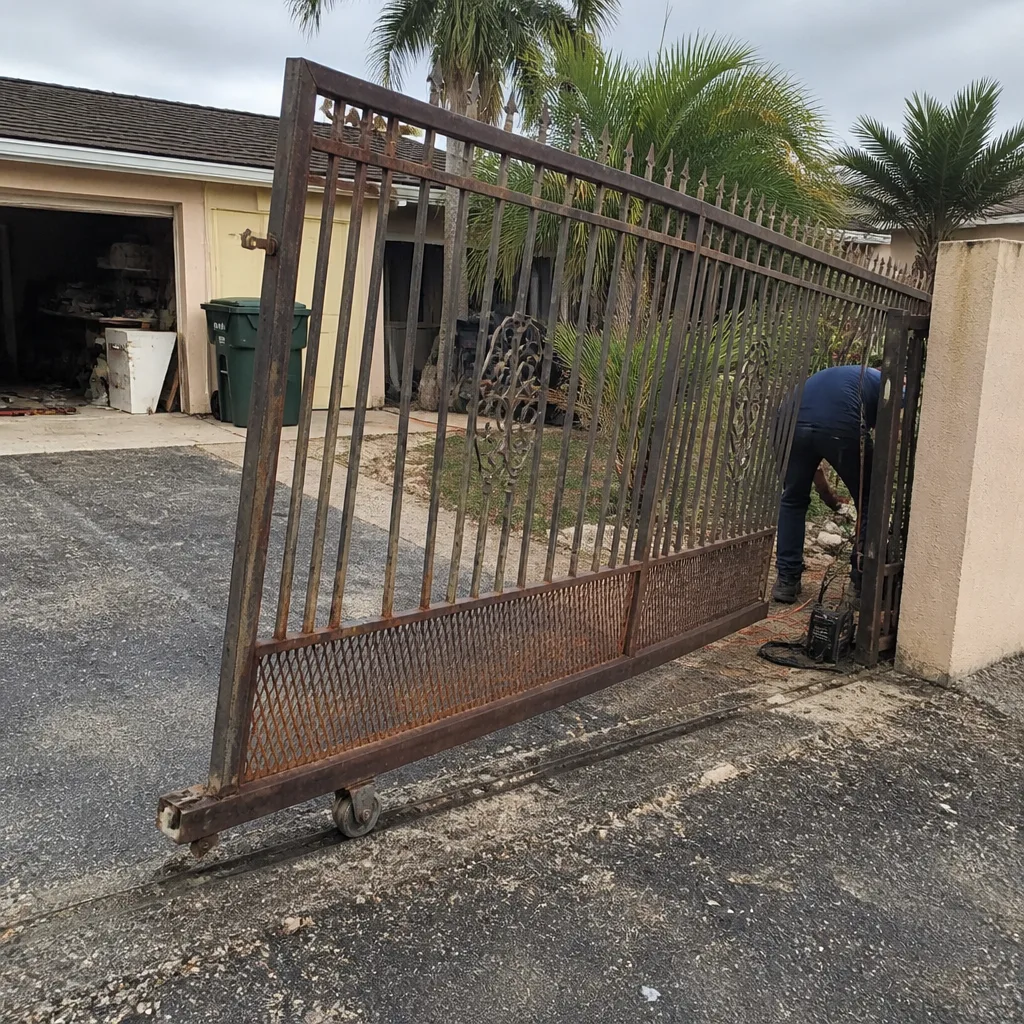
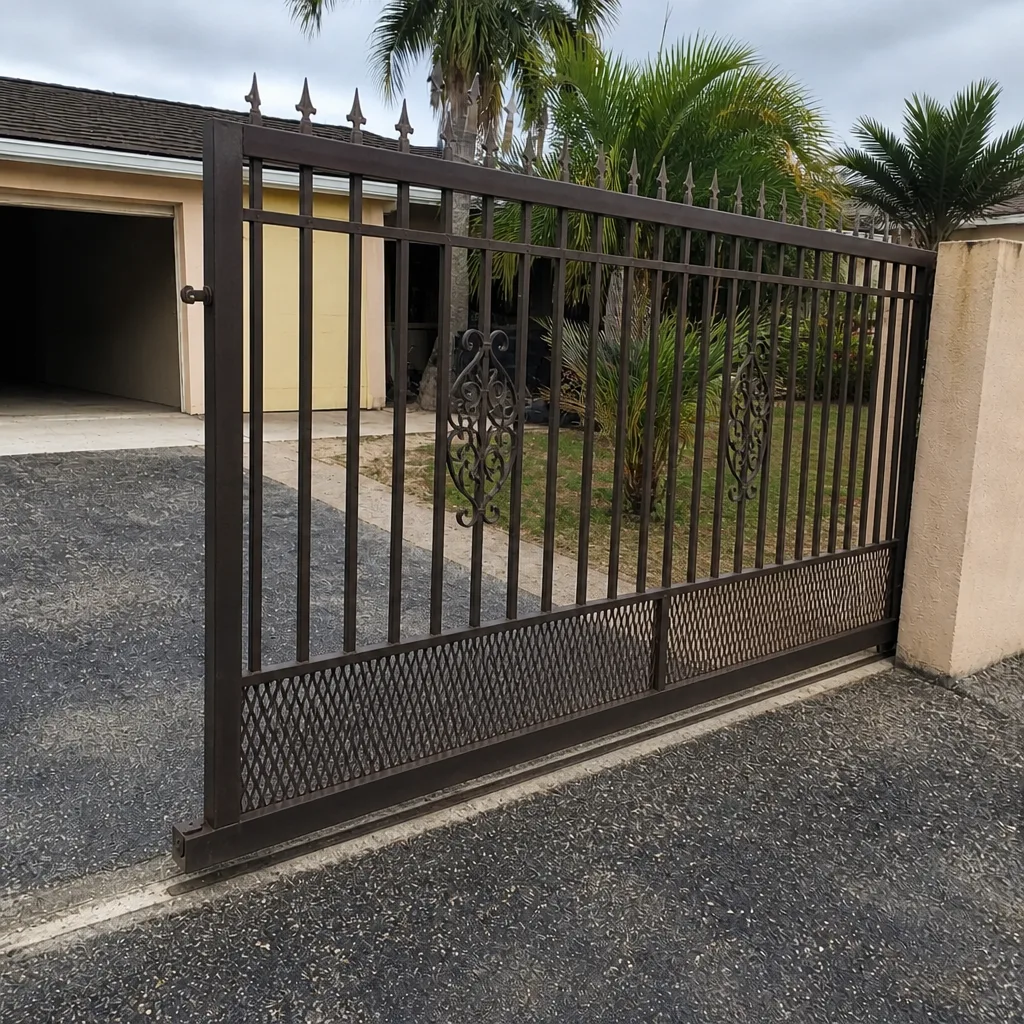
See the difference
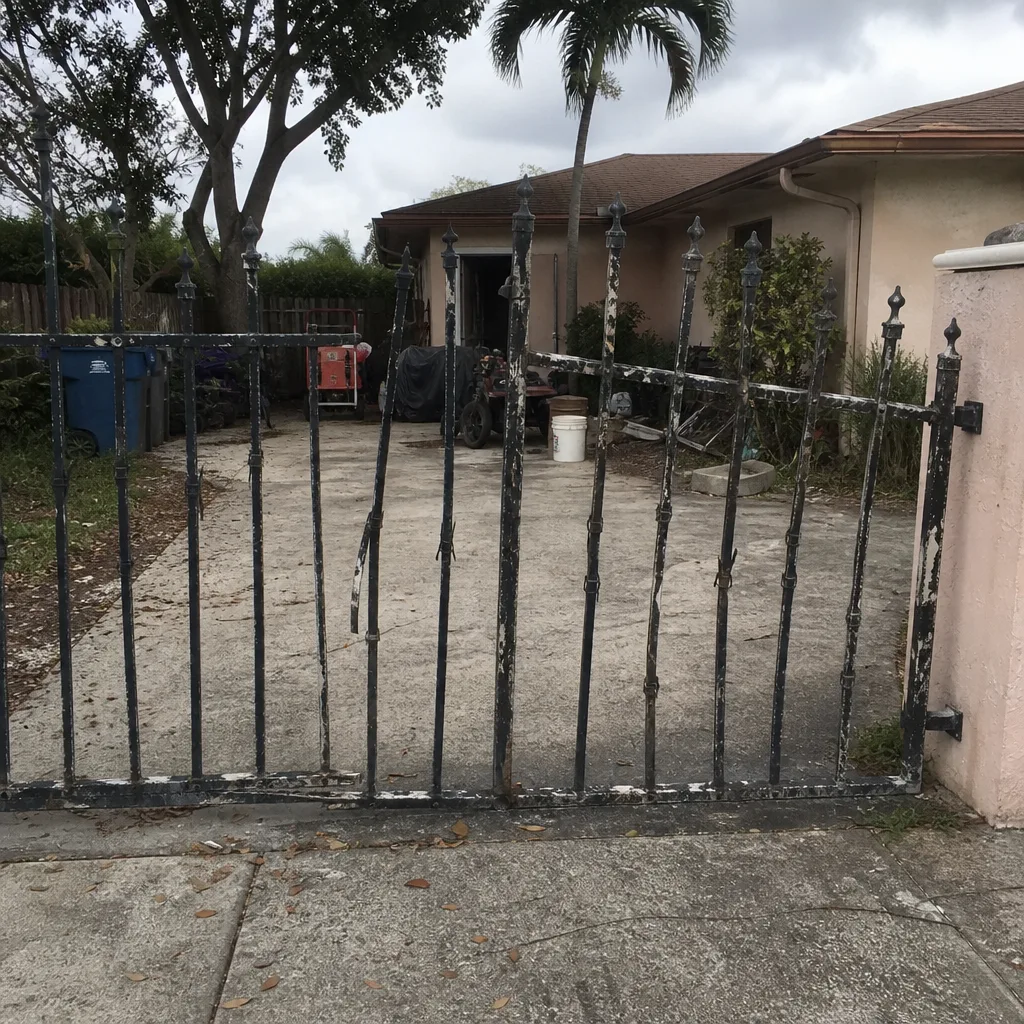 Before
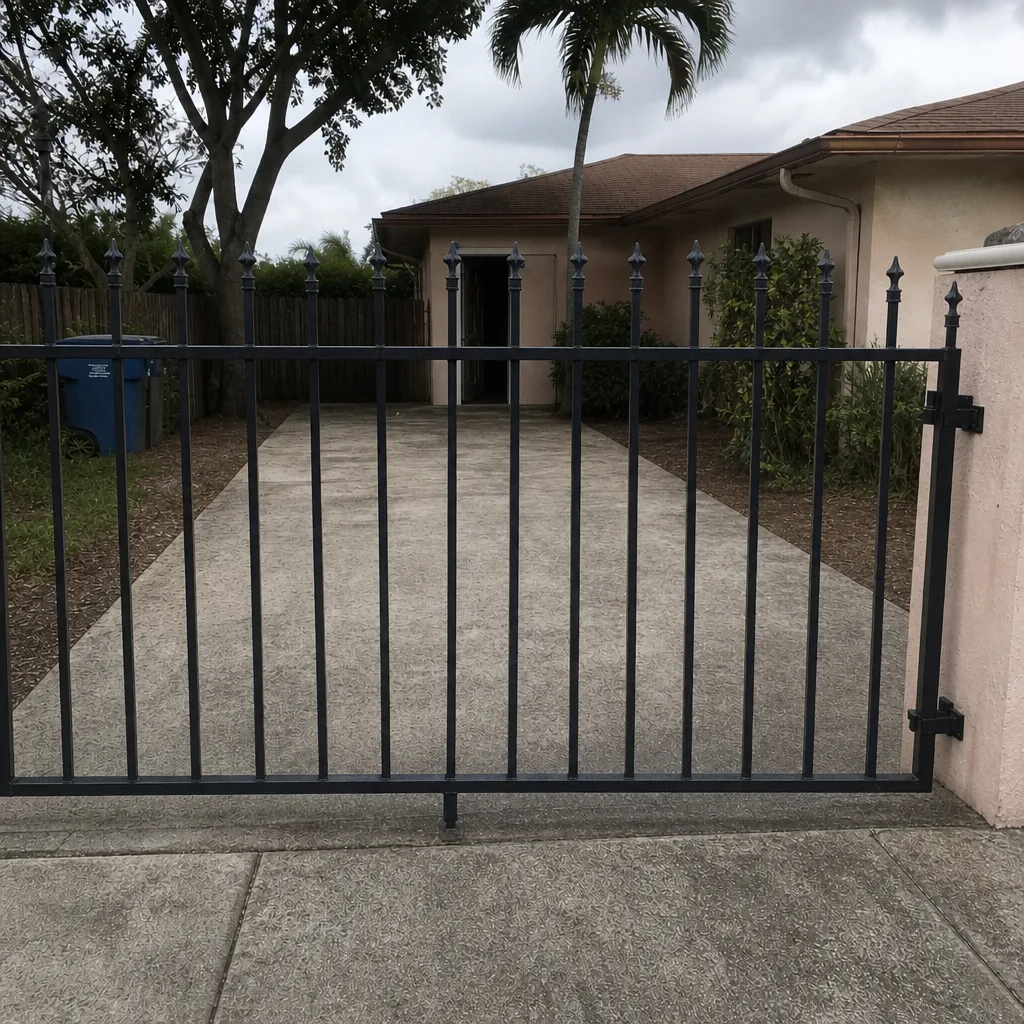 After
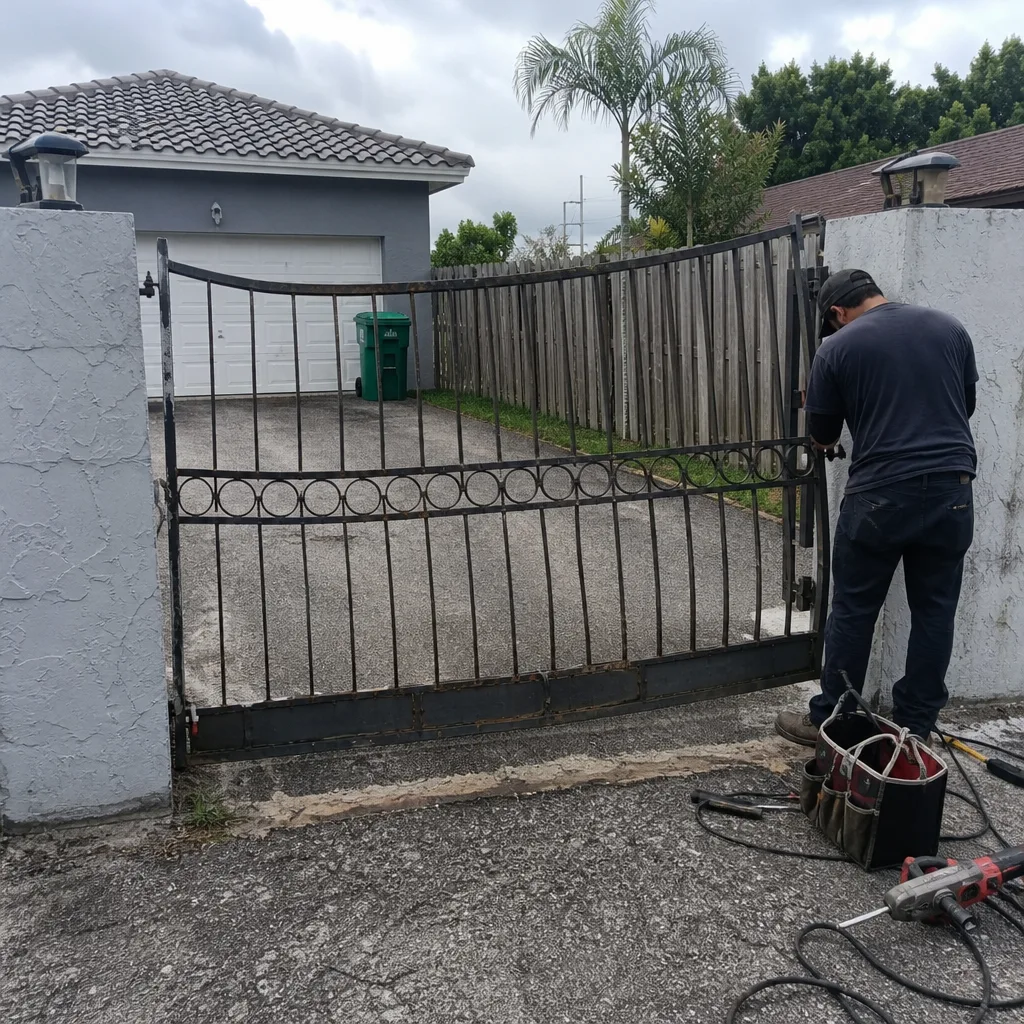 Before
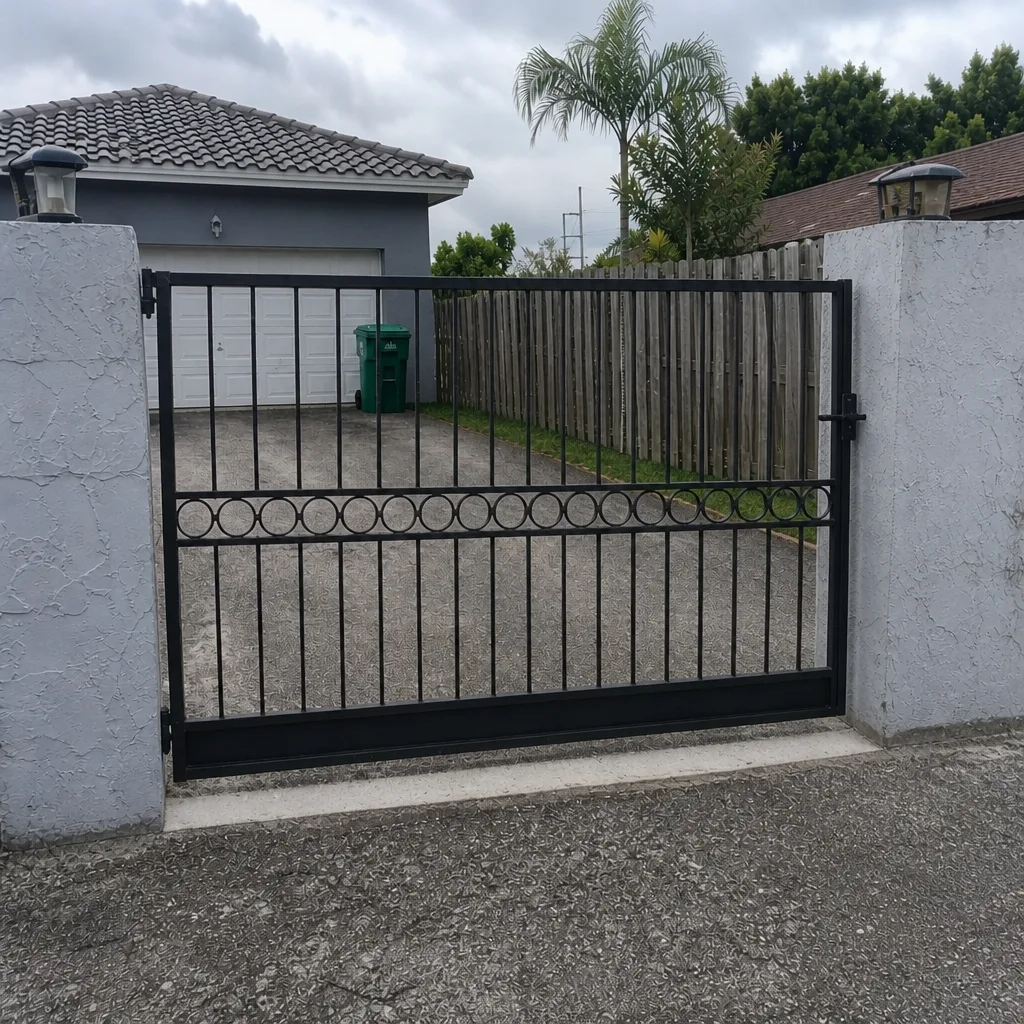 After
 Before
 After
When to Call a Professional
Call a professional when the gate is stuck mid-travel, when the operator responds to the remote with nothing or the wrong movement, when a safety edge or photo eye doesn’t stop the gate on contact, when a heavy panel has dropped or come off the track, or when the same fault has come back after a repair. Electrical faults – a board that’s stopped, wiring that’s been chewed or broken, sensors that trigger without contact – belong with a specialist, not a weekend attempt. The safety edges exist because a moving panel can crush. That danger doesn’t get easier to handle with trial and error. Tidewater Gate Repair offers free estimates in Pembroke Pines – call (877) 748-7198. We answer 24/7. Fast dispatch from 7am to 7pm, Sunday through Friday.
Frequently Asked Questions
Gate repair in Pembroke Pines in 2026 typically runs $150 to $180 for basic mechanical work, $250 to $650 for electrical repairs like sensors, wiring, or control boards, and $400 to $900 for operator-level work on a motor or gearbox. Full replacement generally runs $3,200 to $8,500. The written estimate sets the final price, and the estimate is free. Call (877) 748-7198 for an exact quote.
Same-day service is often available for gate repairs – a stuck gate or a failed operator is exactly the kind of call we’re set up for. We answer 24/7. Fast dispatch from 7am to 7pm, Sunday through Friday. A call outside that window gets booked into the next opening. Call (877) 748-7198 to check availability.
Yes – wiring, safety edges, photo eyes, and control board diagnosis are core to electric gate repair and we handle them as part of the same service call. We don’t offer standalone electrical work outside of gate systems. If your electric gate is acting up, that’s exactly what we’re built for. Call (877) 748-7198 for a free estimate.
Repair is usually cheaper when the operator is otherwise sound and the failure is a single component – a hinge, a sensor, a limit switch. Replacement starts to win when the operator has failed more than once in two years and the repair bills are approaching half the cost of a new install. An on-site estimate is the only way to compare the two honestly. Call (877) 748-7198 to get one.
We service nine brands across residential and commercial applications: LiftMaster, FAAC, BFT, Linear, Viking, Ghost Controls, DoorKing, Elite, and Mighty Mule. Whether your property runs a LiftMaster or a FAAC, we already know the system. If you’re not sure of the brand, the technician identifies it on the first visit. Call (877) 748-7198 with your gate’s information and we’ll confirm.
An itemized invoice with labor and parts on separate lines, the gate location and operator brand, the repair category, and the written estimate attached. For shared gates between neighbors, the same format works as the split document. Ask for photo documentation on request if the HOA board asks for it. Call (877) 748-7198 to discuss documentation before scheduling.
The Bottom Line
The total number on a gate repair quote tells you less than its structure does. A quote that separates diagnosis, labor, and parts – and agrees a price in writing before work starts – is one you can evaluate. A quote that hides diagnosis in parts markup, bundles labor into a single line, or pads the scope is one you can’t, no matter how low it looks. For the same mechanical, electrical, or operator-level repair across Pembroke Pines, the honest range is narrower than the spread between quotes suggests. Read the structure first. Compare the parts lines second. Only then compare the total. That’s how you know whether a quote is fair.
If your gate is stuck, failing, or making a sound it didn’t used to, we work on gates – only gates. Whether it’s a manual swing gate, a residential Pembroke Pines driveway operator, or a commercial-grade common-area slide system, our technicians are set up for that call and no other. We’re Tidewater Gate Repair, and every technician on every job is a gate technician. Call (877) 748-7198 for a free estimate. We answer 24/7. Fast dispatch from 7am to 7pm, Sunday through Friday.
Written by the team at Tidewater Gate Repair.