
Last updated November 15, 2026
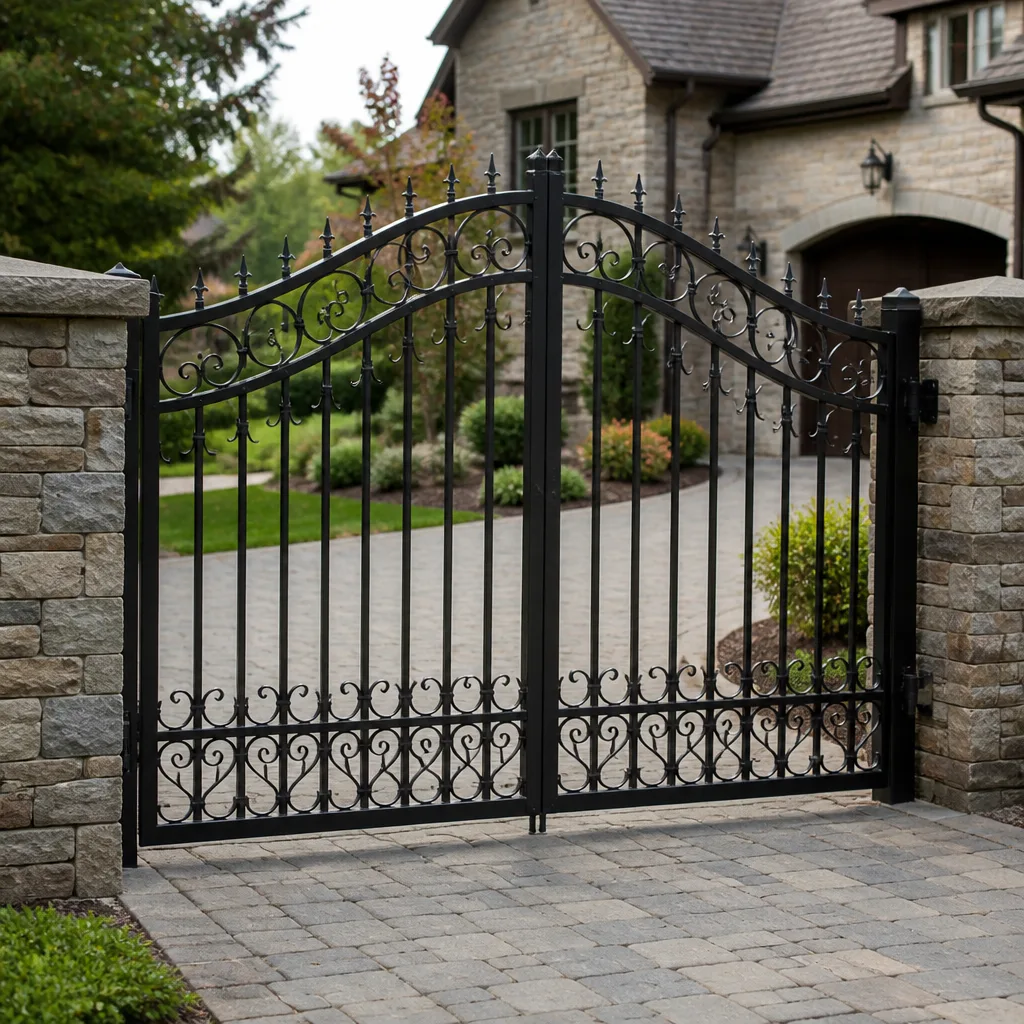 Wrought iron
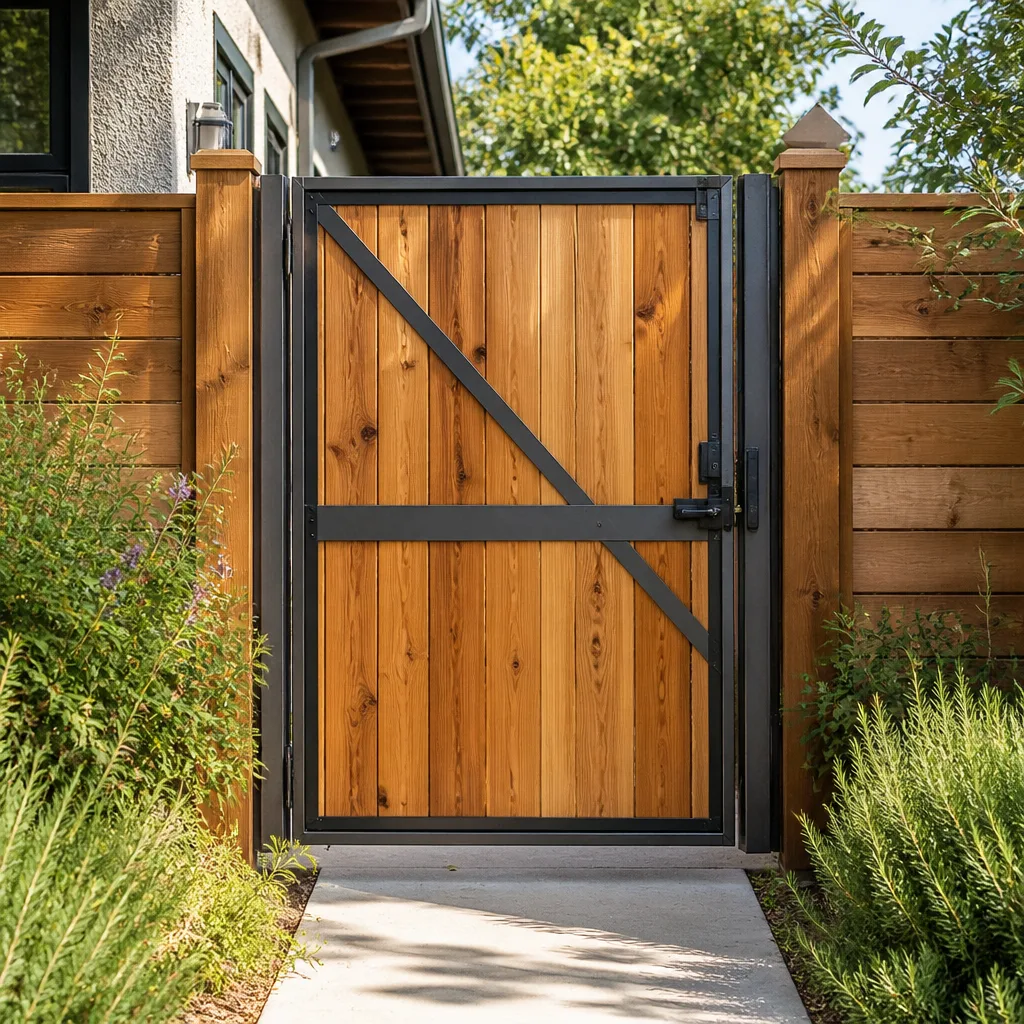 Wood & steel frame
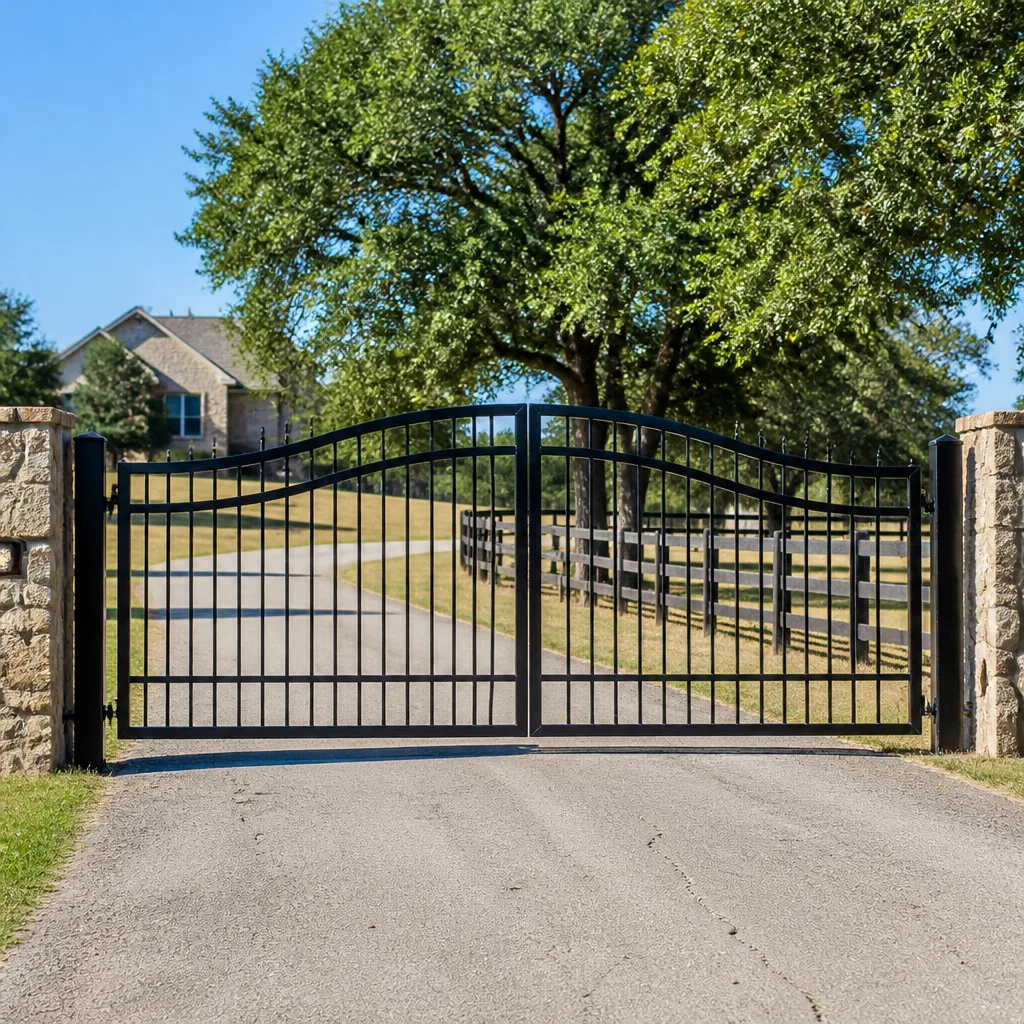 Farm & ranch
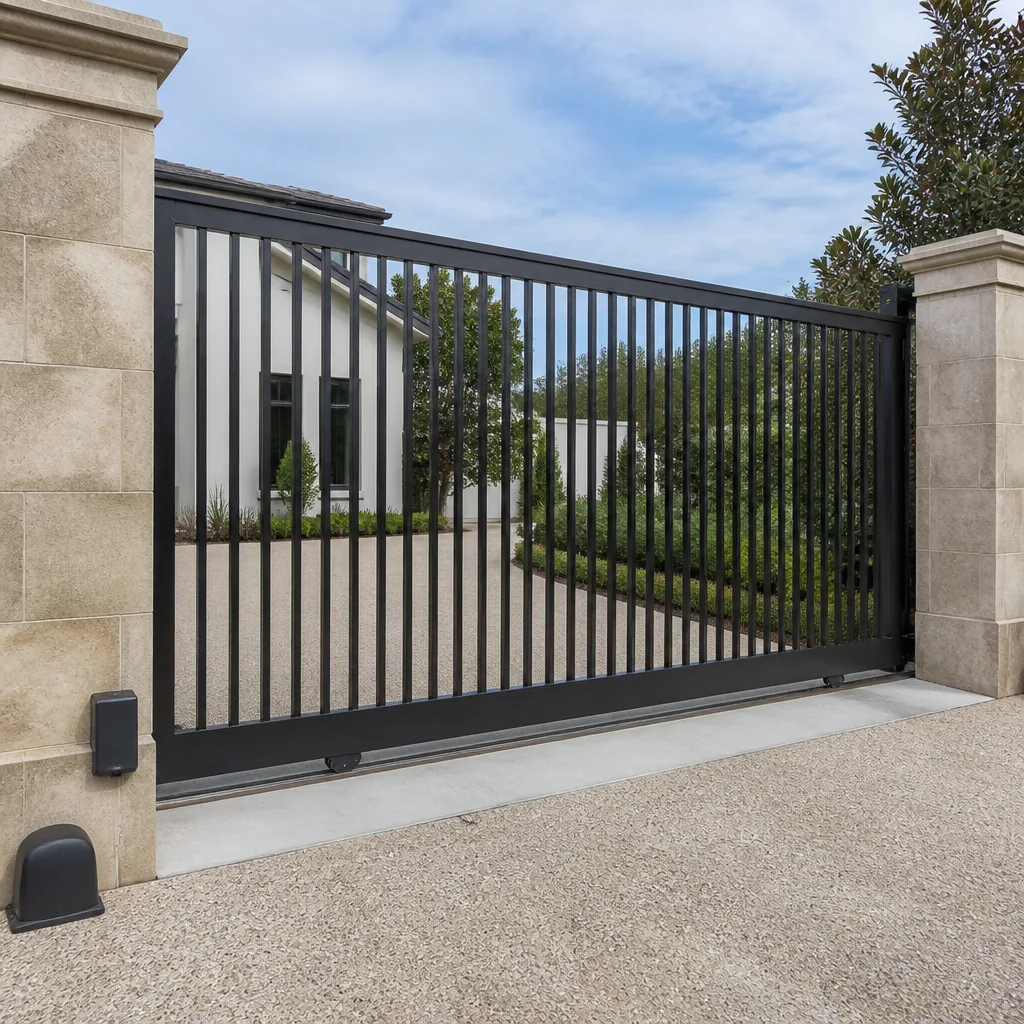 Sliding driveway gates
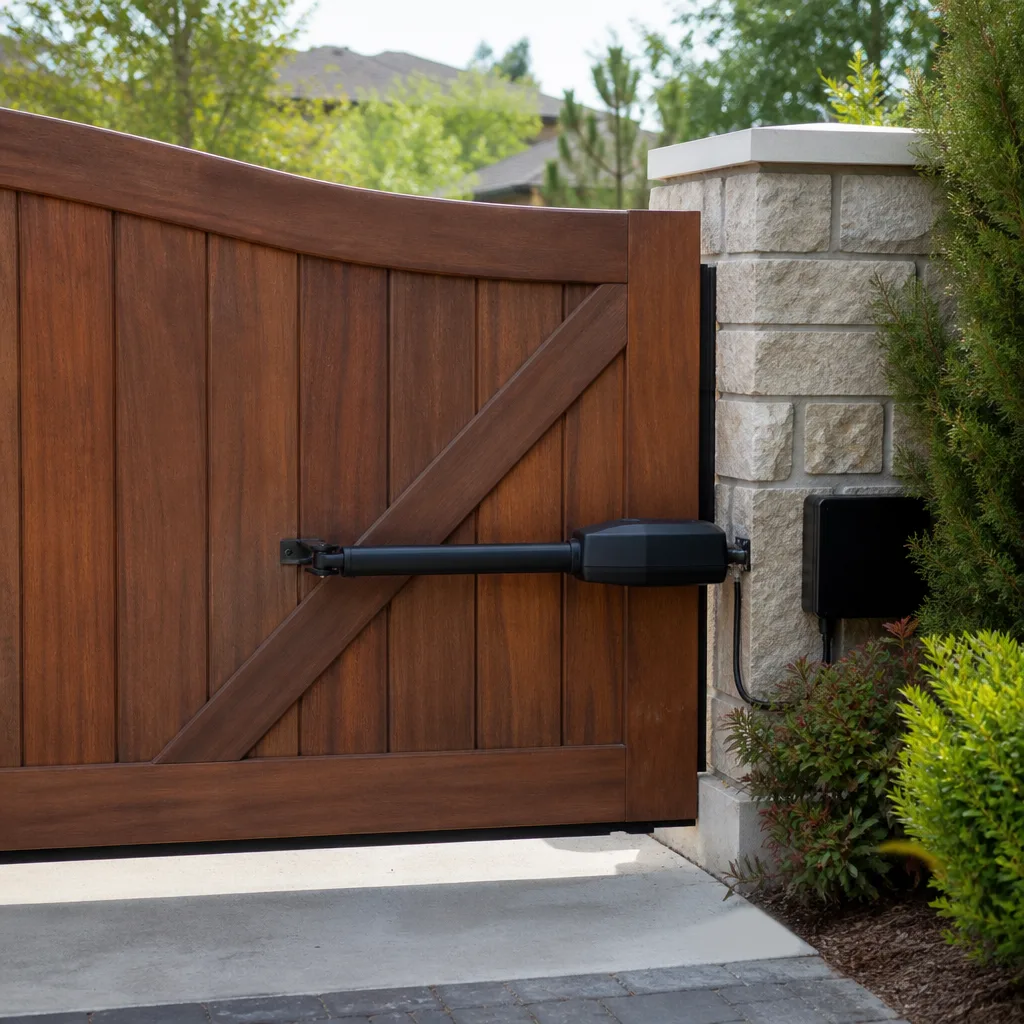 LiftMaster operators
Free on-site gate assessment - hinges, posts, and your LiftMaster or Nice gate operator checked before anything is quoted
The assessment is free and the quote is the invoice.
Get your free estimateGate Repair Warning Signs: A Pembroke Pines Homeowner’s Reference Guide
A gate that reverses direction unexpectedly isn’t malfunctioning. It’s doing exactly what it was programmed to do when it detects resistance. The real question is whether that resistance is a real obstruction, a misadjusted limit switch, or a motor drawing excess current because a bearing is seizing. That distinction changes everything about what the repair involves. In Pembroke Pines, where automated gates guard everything from single-family driveways in Chapel Trail to community entrances off Pines Boulevard, the difference between a quick adjustment and a major component replacement usually shows up in one detail: which part of the operating cycle the symptom appears in. This guide maps those symptoms to their likely causes so you can describe the problem accurately, document it properly, and know when to stop using the gate entirely.
Quick Answer
Gate repair warning signs fall into two categories: signs that mean the gate needs a professional adjustment soon, and signs that mean it’s a safety hazard and should be shut off immediately. Reversing mid-travel, grinding noises during movement, and gates that stop partway through a cycle usually point to limit switch problems, worn hardware, or a failing operator. Any sign of a gate that moves when it shouldn’t, falls off its track, or has damaged safety edges is an immediate stop-and-call situation. In Pembroke Pines, the year-round heat and sun accelerate wear on motors, control boards, and wooden infill panels faster than in cooler climates.
Styles & brands we work with
- Wrought iron
- Wood & steel frame
- Farm & ranch
- Sliding driveway gates
- LiftMaster operators
Table of Contents
- Symptom-to-Cause Mapping by Operating Phase
- What Your Gate’s Sounds Are Telling You
- Visual Warning Signs Specific to South Florida Conditions
- Warning Signs That Require Immediate Shutdown
- Signs You Can Monitor Without Stopping Use
- How to Document Warning Signs Before a Service Visit
- Manual Gate vs. Electric Gate: Different Warning Signs
- The Pembroke Pines Seasonal Pattern
Symptom-to-Cause Mapping by Operating Phase
Where a symptom appears in the operating cycle tells a technician more than the symptom itself. A gate that fails to start and a gate that fails to close might both involve the motor, but the diagnostic paths are completely different. Here’s how the four main operating phases break down.
Failure at start (gate won’t begin moving)
- Completely silent when triggered: Usually a control board, receiver, or power supply issue. On LiftMaster and Elite operators, a dead receiver or a tripped transformer stops the cycle before it starts.
- Clicks but doesn’t move: Points to a relay firing without the motor engaging. Could be a failed capacitor on AC operators or a binding mechanism preventing the motor from overcoming static load.
- Hums but doesn’t move: The motor is receiving power but mechanically cannot rotate. On slide gates, this often means debris in the track or a seized roller. On swing gates, a failed hinge or a sagging post.
Failure mid-travel (gate starts then stops partway)
This is the most diagnostically rich failure pattern. A gate that makes it partway through the cycle and then stops is usually fighting something: a limit switch that’s been knocked out of position, a current-sensing function reading excessive draw from a binding mechanism, or an obstruction the gate perceives but doesn’t physically touch. On Mighty Mule and Ghost Controls residential operators, mid-travel stops frequently trace to a limit switch that’s drifted after months of thermal expansion and contraction in Florida heat.
Failure near close (gate reaches the end but won’t latch or reverse)
A gate that travels the full distance but reverses before closing usually has a safety device triggering. The photoelectric eye may be misaligned, dirty, or blocked by vegetation. The safety edge may have a short. On commercial-grade systems like DoorKing, the close-limit switch itself may have failed, causing the operator to think it hasn’t reached the closed position when it physically has.
Failure during remote trigger (works from keypad, not remote, or vice versa)
When the gate works from one input but not another, the mechanical system is likely fine. The problem is in the access control chain: a dead remote battery, a receiver issue, a keypad with a failed button, or an interference problem from nearby electronics. This is almost never a heavy repair, but diagnosing it requires actually testing each input separately.
What Your Gate’s Sounds Are Telling You
Gate operators make four distinct categories of sound, and each one points to a different subsystem. Our technicians have up to 9 years of experience, and sound is often the first thing we’re able to interpret before we even touch the system.
Grinding
Grinding during movement means metal is contacting metal where it shouldn’t. On swing gates, it usually comes from worn hinges or a roller assembly that’s lost its bearing. On slide gates, grinding points to track wear, a bent roller, or a drive gear that’s lost its teeth. Grinding is never normal and gets worse with continued use. On AC operators, grinding from inside the housing usually indicates gearbox wear.
Clicking
A single click when you trigger the gate is normal; that’s a relay engaging. Repeated clicking without movement means the control board is trying to start the motor but something is interrupting the sequence. This can be a failing capacitor, a loose connection, or a safety device tripping in rapid succession. On DC operators, rapid clicking often accompanies a battery that can’t hold enough charge to complete the cycle.
Humming
Humming means power is reaching the motor but the motor isn’t turning. On AC systems, a bad start capacitor is the most common cause. On DC systems, it may indicate a motor winding failure or a controller sending the wrong signal. Continued humming without movement will overheat the motor and turn a repairable component into a replacement. Shut it off if this continues past a few seconds.
Silence
A completely silent gate when triggered means no power or no signal is reaching the operator. Check the obvious first: a tripped breaker, a reset GFCI, or a control panel in a fault state. If power is confirmed at the operator, silence usually indicates a failed control board, a dead receiver, or a wiring fault between the access control and the operator.
Visual Warning Signs Specific to South Florida Conditions
Pembroke Pines sits in a subtropical climate with intense UV exposure and heavy summer rains. That combination produces wear patterns that homeowners moving here from cooler regions don’t always recognize as warnings.
Rust bleed patterns
Rust streaks running down from hinges, hinge plates, or track bolts are a normal sign of age on exterior hardware. But rust bleeding from a welded joint or from behind a mounting plate can indicate a deeper structural issue: water has penetrated where it shouldn’t, and the metal underneath may be thinning. On older gates in Pembroke Pines neighborhoods, hinge posts are common failure points because water pools at the base.
UV-chalked powder coat
Powder-coated aluminum gates develop a chalky surface over years of sun exposure. That’s cosmetic in itself, but when the powder coat starts to flake or peel, the bare aluminum underneath is exposed to rain and begins to pit. Pit corrosion on a structural tube weakens the gate over time and can eventually cause a sudden failure. Look at the corners and joints where the coating tends to fail first.
Swollen wood infill panels
Many Pembroke Pines properties have gates with wood or composite infill set into metal frames. Even pressure-treated wood absorbs moisture during the summer rainy season and swells. Swollen panels push against the frame, warping the gate and altering its hang. On swing gates, this is a frequent cause of sagging and dragging. If panels appear tight, split, or showing gaps at the frame, they’re moving and should be inspected before the gate’s geometry is permanently thrown off.
Other South Florida visual signs
- Sun-bleached control boxes: Plastic enclosures that have yellowed and cracked admit water during storms.
- Standing water near footing: Persistent puddles around the gate post base accelerate corrosion and can undermine post stability.
- Sagging post: A post that’s begun to lean, even slightly, needs attention before the gate drags and damages the operator or frame.
- Mildew on safety edges: Black growth on rubber safety edges can hide cracks and short circuits that disable the safety feature.
Warning Signs That Require Immediate Shutdown
Some warning signs mean the gate needs adjustment soon. Others mean the gate should not be used to move until a technician has inspected it. These are the signs that put people and property at risk.
- The gate moves when it shouldn’t: Any movement without a trigger, especially movement during a power outage or while someone is in the path, is a critical failure. Disconnect power to the operator immediately.
- Safety edges fail to reverse the gate: Test the reversing function by gently applying pressure to the safety edge. If the gate does not reverse on contact, the safety system has failed and the gate is not safe to operate.
- Photoelectric eyes are damaged or misaligned: If the eyes are broken, dirty beyond cleaning, or unable to realign, the gate can close on an obstruction. Shut the gate down.
- Slide gate has come off the track: A gate that has partially disengaged from its track can drop or swing unpredictably. Do not attempt to move it back onto the track physically.
- Arcing or burning smell: Any electrical smell, visible arcing, or hot-to-the-touch control box indicates a wiring fault or failing component. Shut off the power at the breaker.
- Sagging or leaning gate post: A post that has visibly moved means the gate frame is under abnormal stress. Continued operation can cause sudden structural failure.
For any of these, the right move is to cut power at the breaker, keep people clear of the gate, and call a specialist. A gate has no torsion springs to worry about the way a garage door does, but heavy panels that can crush and slide gates that come off the track are just as serious. Electric gate repair is a distinct service for exactly this reason; electrical faults in an operator should not be treated like a hardware adjustment.
Signs You Can Monitor Without Stopping Use
Some symptoms are worth watching and addressing at the next available service visit, as long as they don’t worsen or trigger any of the immediate-shutdown conditions above.
- Intermittent remote range problems: The gate eventually opens but you have to be closer or press twice. Monitor and check batteries; book a visit if it keeps happening.
- Slow cycle time: The gate takes noticeably longer to open or close than it used to. This can point to mechanical drag or a motor losing efficiency, and it’s worth measuring so you can report whether it’s getting worse.
- Cosmetic rust bleeding: Rust streaks that don’t come from a structural weld can usually wait, but note where they appear.
- Chalky powder coat or fading paint: Cosmetic and non-critical, but track it because exposed bare metal will start to corrode.
- Slight increase in noise: A gate that’s always hummed is different from a gate that’s newly humming. Compare it to how it used to sound.
- Occasional wobble or rattle: A gate that wobbles only in high wind may just need bolts checked. A gate that changes behavior permanently is a warning.
Book gate repair for these on a normal schedule, and be prepared to stop using the gate if any symptom jumps into the immediate-shutdown list.
How to Document Warning Signs Before a Service Visit
Good documentation cuts diagnosis time and helps the technician arrive with the right parts and the right brand-specific knowledge. Here’s how to do it well.
- Identify the brand and model plate. Every operator has a label on the housing. Photograph it clearly. Whether you own a DoorKing, a LiftMaster, or a Mighty Mule, the model number determines what components the technician brings.
- Record the operating cycle on video. A single 30-second video of the gate going through a complete cycle (open, pause, close) tells a technician more than any description. Do it twice so you catch both directions.
- Narrate what you’re seeing as it happens. “It’s stopping right about here” while the gate stalls is more useful than “it stops halfway.” Note the position.
- Time the trouble. How many seconds into the cycle does the failure occur? Is it consistent or intermittent? Intermittent symptoms are often the hardest to diagnose remotely.
- Note environmental conditions. Does it happen only in the afternoon heat? Only after rain? Only on the first cycle of the day? This kind of context is diagnostic gold.
- Photograph structural points. Close-up shots of every hinge, hinge plate, roller, and post base. Include one wide shot showing the whole gate so the technician can see the frame geometry.
- Photograph control equipment. Open the control box carefully and photograph the board, any diagnostic LEDs, and the wiring terminals. LEDs, in particular, will often show a fault code.
Accurate documentation reduces the number of trips required and helps ensure the written estimate matches the actual problem. The price is always quoted and agreed before any work starts, so a clear up-front description helps both sides.
Manual Gate vs. Electric Gate: Different Warning Signs
Manual and automated gates fail in different ways. Knowing which category you’re working with shapes what to watch for.
Manual gate warning signs
- Gate doesn’t swing freely: A manual gate should move with light pressure. If you have to push hard, the hinges are worn or the post has shifted.
- Dragging on the ground: A manual swing gate that drags has a sagging frame. Left alone, this deforms the gate itself.
- Loose hinge plates: Bolts that have backed out of the wood or metal frame weaken the mounting.
- Sticking latch: A latch that requires two hands or extra force will eventually fail in a way that leaves the gate open.
- Warped panels: Wooden infill that’s warped will bind against the frame or make the gate difficult to open and close completely.
Electric gate warning signs
- Gate reverses without obstruction: Safety device or limit switch issue; usually repairable but needs diagnosis.
- Gate stops partway: Often limit switch drift or current-sensing trip.
- Remote or keypad inconsistent: Access control chain fault.
- Motor hums without moving: Capacitor, gearbox, or control board failure.
- Diagnostic LED codes on the control board: Each brand uses its own fault codes; a LiftMaster and an Elite won’t mean the same thing.
- Battery backup not holding: Common on DC operators as batteries age; behavior changes during grid-off conditions.
If you own a gate in a Pembroke Pines community managed by an HOA, the operator may be a commercial-grade system like a FAAC or DoorKing rather than a residential platform. These systems have their own diagnostic patterns, and documenting them requires a slightly different approach.
The Pembroke Pines Seasonal Pattern
Gate failures don’t happen at random in Pembroke Pines; they follow the climate’s rhythm. Understanding that pattern helps you anticipate problems before they leave a gate stuck open.
The wet season, roughly May through October, brings daily afternoon storms and the most gate activity of the year as residents use their gates more and vegetation grows faster. That combination stresses every component: water infiltration into control boxes, foliage blocking photoelectric eyes, and swollen wood infill causing drag. It’s the season when limit switch drift becomes most noticeable, because the gate starts needing adjustment after every significant weather event.
The dry season brings intense UV exposure without the rain. Powder coats chalk. Rubber seals dry out and crack. Batteries lose capacity in the heat. And the cooler dry air often makes small misalignments more audible, since operators that were quiet through the humid months start producing new rattles.
The dry season is the right time to schedule a full inspection for a Pembroke Pines gate. Repairs done in the dry season mean fewer water-related failures the following summer and lower the risk of a gate failing during the worst of the wet season.
If you’re considering Tidewater Gate Repair for your property, it’s worth knowing that we work on gates, only gates. Whether your operation is a single residential system or a community entrance running commercial-grade FAAC or BFT equipment, the pattern of failures in Pembroke Pines is familiar to us.
Common Mistakes to Avoid
- Assuming any reversing is a safety issue. Reversing can mean a real obstruction, a misadjusted limit, or a failing motor drawing excess current. It needs diagnosis, not a default response.
- Ignoring a slow cycle. A gate that’s gradually getting slower is telling you something is binding. Waiting until it stops completely can turn a small repair into a motor or gearbox replacement.
- Spraying lubricant on everything. Lubricating the wrong components attracts grit and accelerates wear. Ask before you spray.
- Bypassing or disabling safety edges. A gate with a non-functional safety edge is not safe to operate. Disabling the feature is the opposite of fixing the problem.
- Pushing a stuck slide gate back onto its track. A slide gate that’s come off the track is a crush hazard. Shut off the operator and call a technician.
- Using a generalist for an electrical fault. An electrical fault in an operator requires a gate specialist, not someone learning on the job at your expense.
- Waiting until a gate fails completely before booking. In Pembroke Pines, the wet season is when gates will fail hardest. Address warning signs before summer rains are pushing water into every seam.
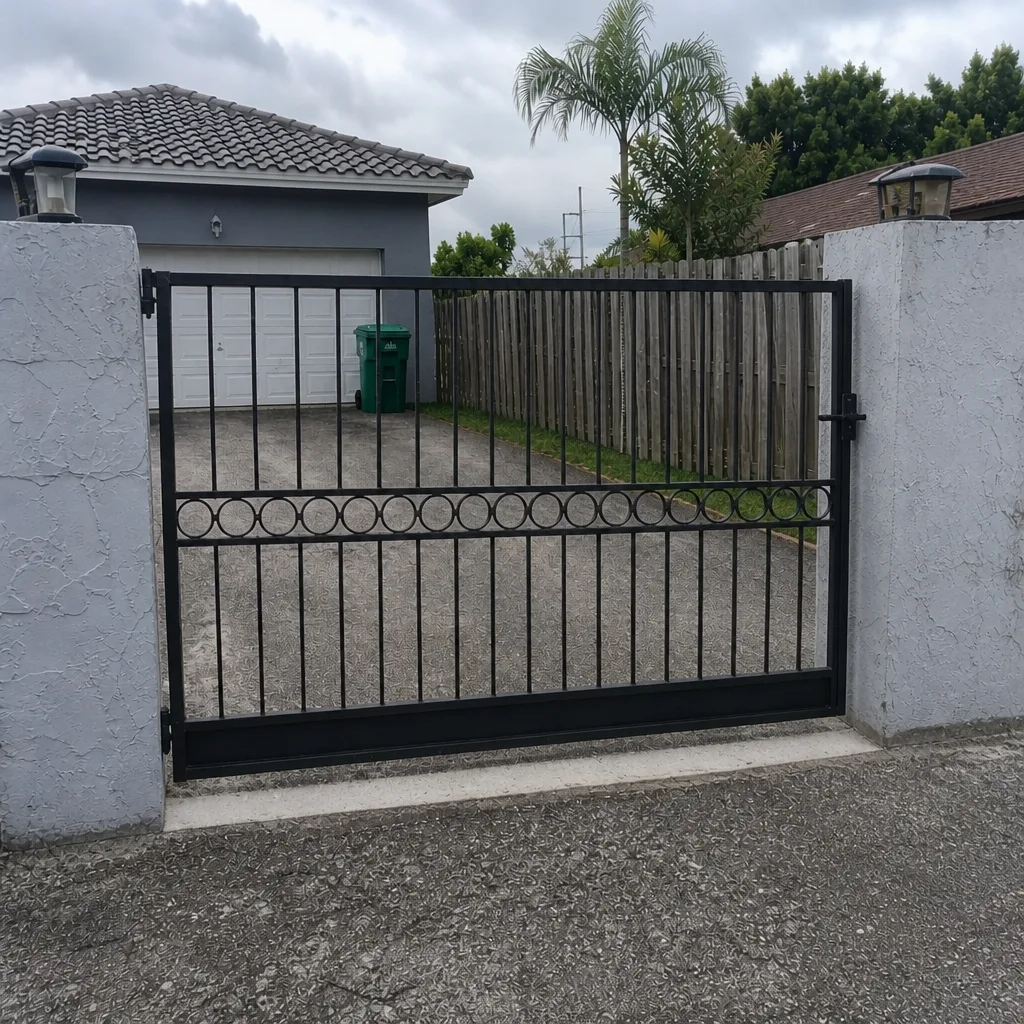
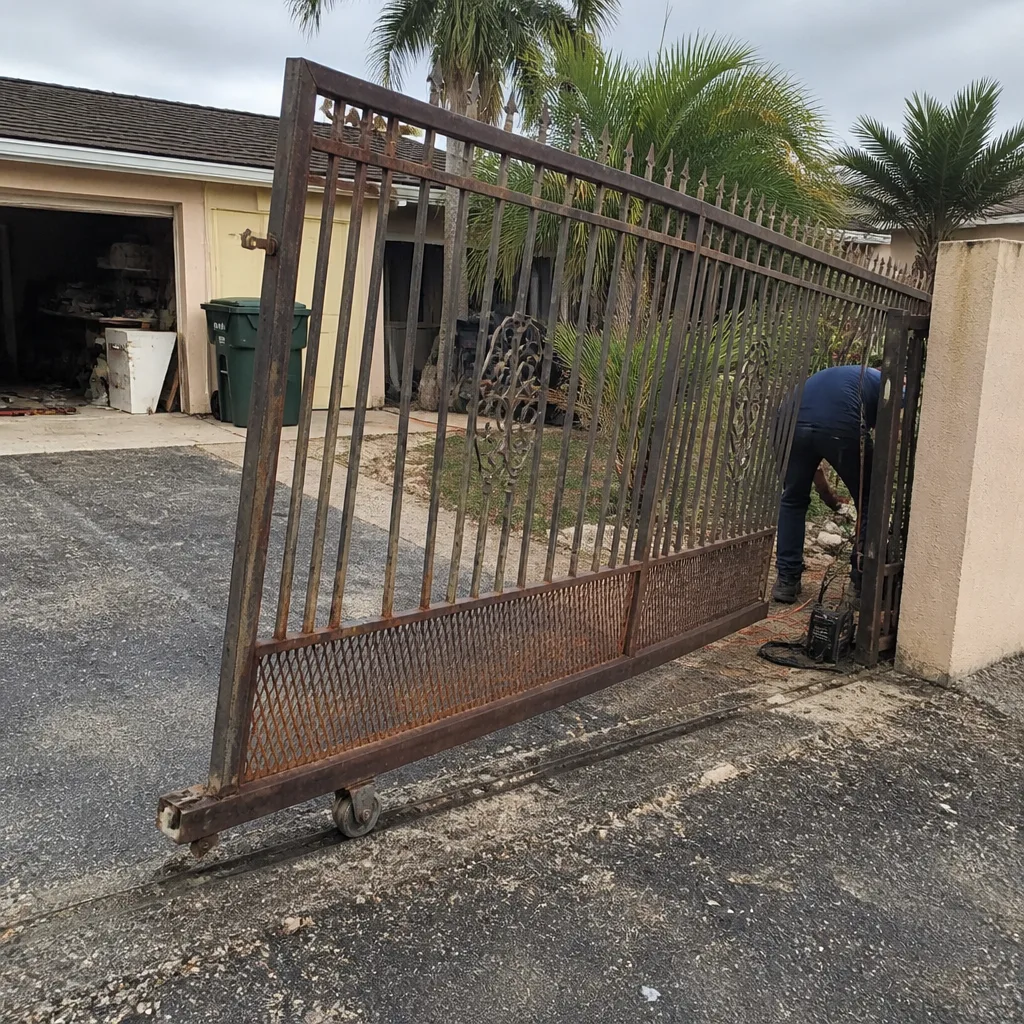
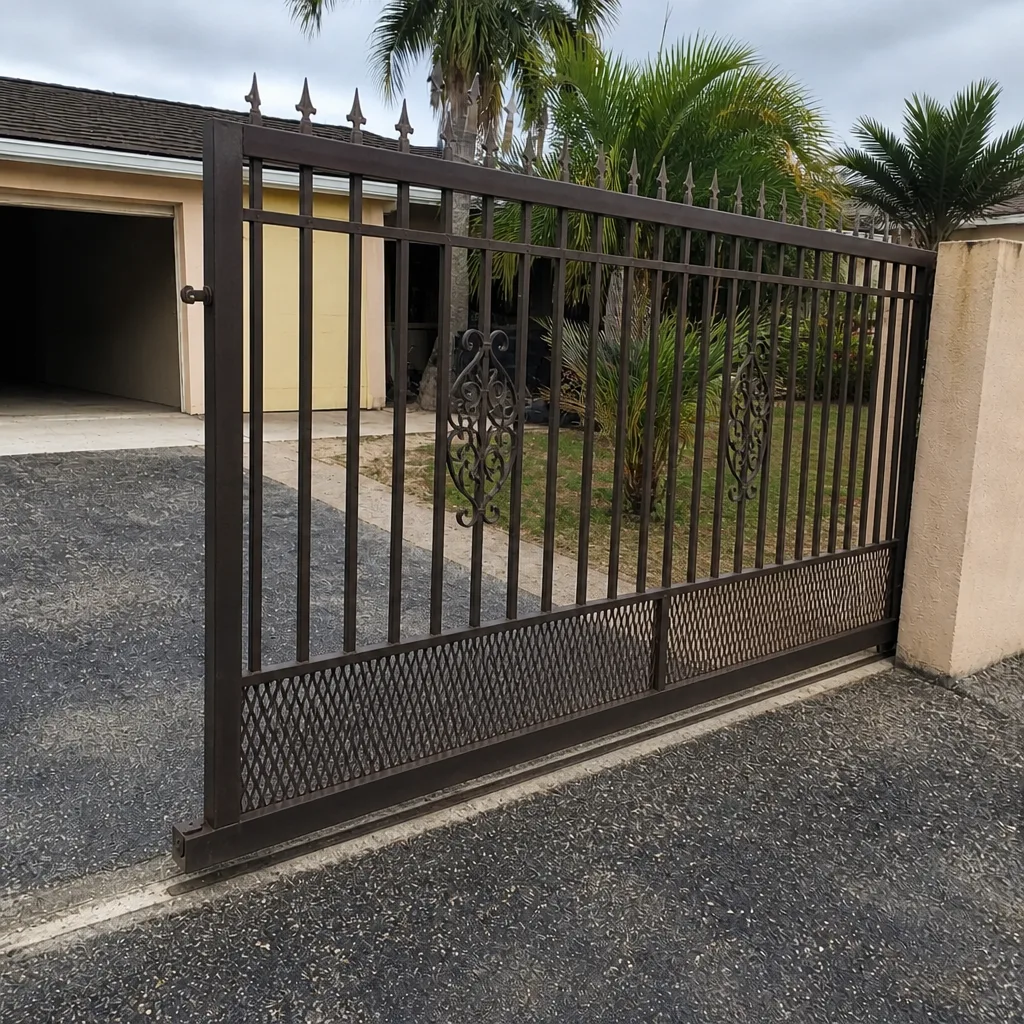
See the difference
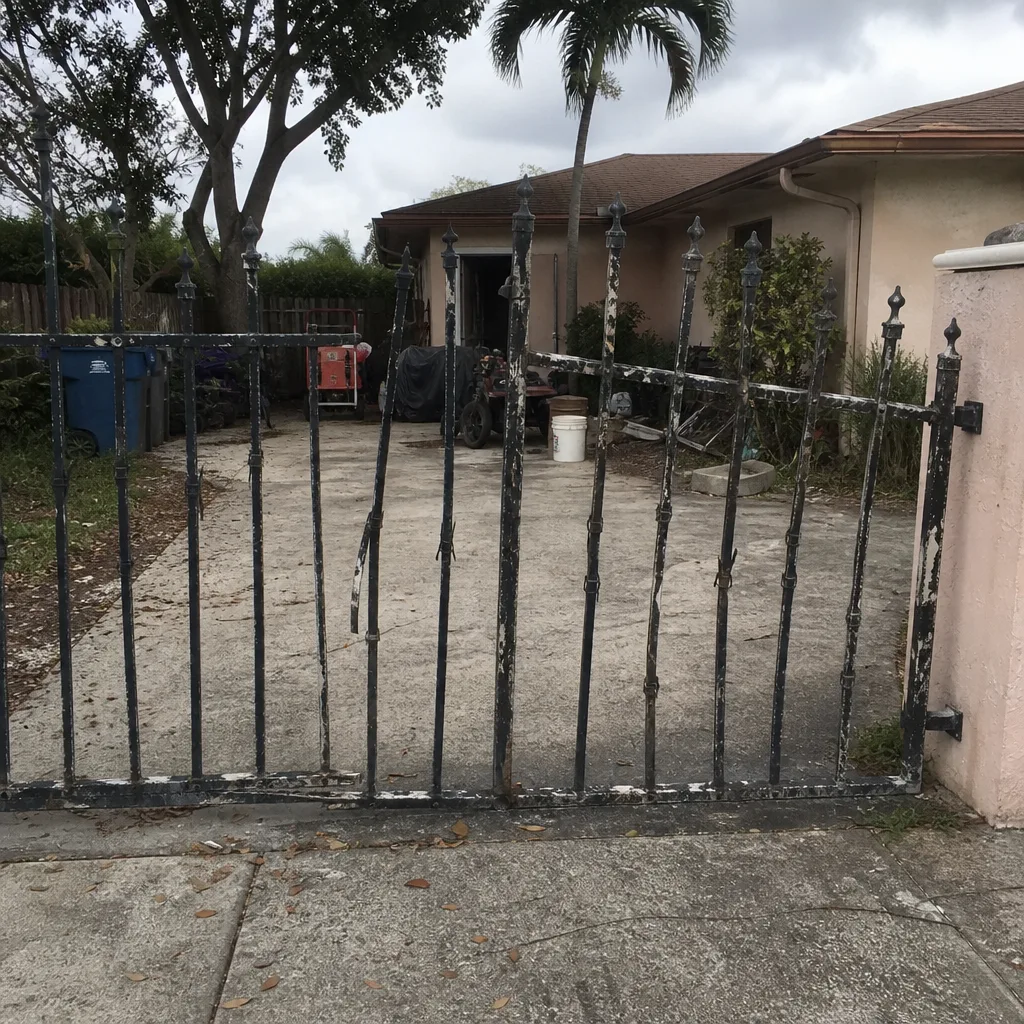 Before
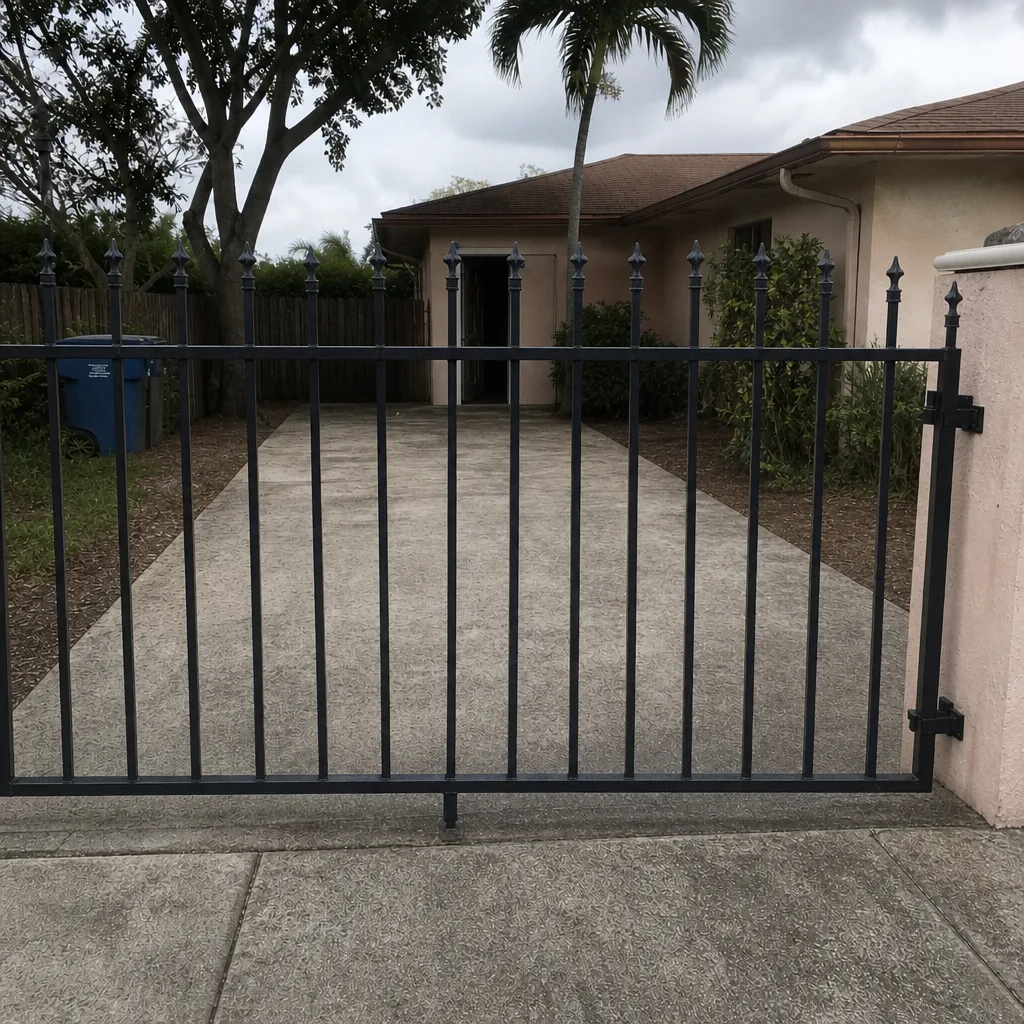 After
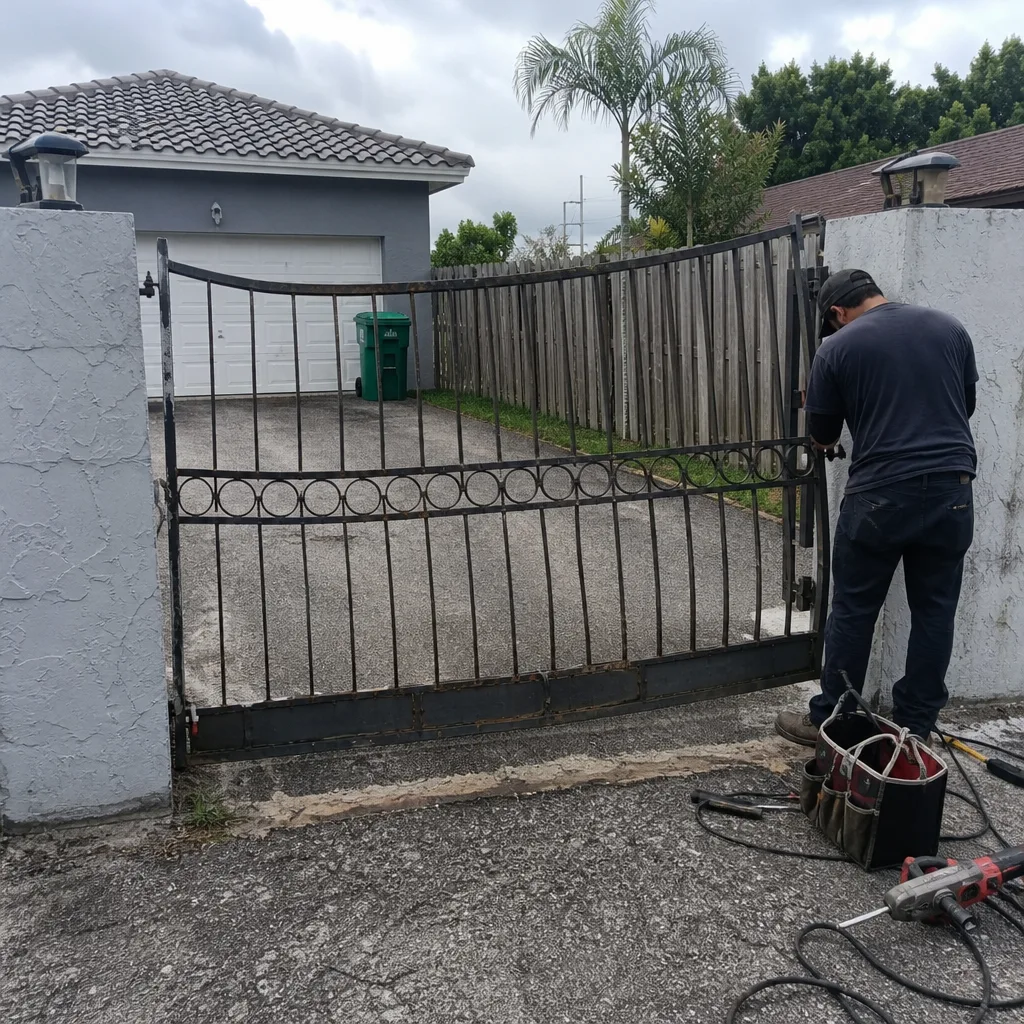 Before
 After
 Before
 After
When to Call a Professional
Call a professional when the gate shows any immediate-shutdown sign: unexpected movement, damaged safety edges, arcing, burning smell, or a slide gate off its track. Call when the gate works intermittently or the remote works sometimes but the keypad doesn’t. Call when a manual gate has become noticeably harder to move, or when a post has begun to lean. And call when you’re not sure which category your symptoms fall into: a trained eye can save you from either unnecessary shutdown or dangerous continued use. Tidewater Gate Repair offers free estimates in Pembroke Pines – call (877) 748-7198. We answer 24/7. Fast dispatch from 7am to 7pm, Sunday through Friday. Our technicians have up to 9 years of experience, and we service both residential and commercial systems across nine major brands.
Frequently Asked Questions
The most common warning signs in Pembroke Pines are reversing without obstruction, stopping partway through a cycle, grinding or humming during movement, inconsistent remote or keypad operation, and visual signs of corrosion or swollen wood panels. The combination of intense sun and heavy seasonal rain accelerates wear on control boards, motor components, and exterior hardware. Any of these symptoms is worth a professional look before it becomes a bigger repair. Call (877) 748-7198 for a free estimate.
A gate warning sign is an emergency when it involves unexpected movement, failed safety edges, arcing, a burning smell, or a slide gate off its track. These indicate a genuine safety hazard and the gate should be shut down at the breaker immediately. Non-emergency signs like cosmetic rust or occasional remote problems can be monitored and addressed at the next available service visit. When in doubt, treat it as an emergency and call (877) 748-7198 – we answer 24/7.
You can operate a grinding gate short-term, but the grinding is metal-on-metal contact that gets worse with every cycle. Continued use accelerates wear on hinges, rollers, or gears. Have it inspected before the damage spreads. Call (877) 748-7198 to book a free estimate.
Yes – the combination of intense UV exposure and heavy summer rains accelerates wear on gate systems in Pembroke Pines and the surrounding area. Powder coats chalk and peel, wood infill swells during the wet season, control boxes crack, and batteries lose capacity in the heat. Gates in this climate need inspection more often than gates in cooler, drier regions. Call (877) 748-7198 for a free estimate.
Adjustment problems usually show up as gates that travel the full cycle but stop short or reverse at predictable points – limit switch drift and minor hardware wear are common examples. Major repairs show up as motor failure, control board failure, structural damage, or a gate that won’t move at all. Accurate symptom documentation in the days before the visit helps a technician make the call faster. Call (877) 748-7198 for a free estimate.
A gate specialist in Pembroke Pines should be able to handle both residential platforms and commercial-grade systems, since the area has everything from single-family driveways to HOA entrances. Tidewater Gate Repair services nine brands, including LiftMaster, FAAC, BFT, Linear, Viking, Ghost Controls, DoorKing, Elite, and Mighty Mule. Whether your property runs a LiftMaster or a FAAC, we already know the system. Call (877) 748-7198 for a free estimate.
The Bottom Line
Gate warning signs are only useful if you know which part of the operating cycle they appear in, and which category of problem they point to. Reversing, stopping partway, humming, and grinding each mean something different depending on whether they happen at start, mid-travel, near close, or during a remote trigger. In Pembroke Pines, those symptoms get amplified by intense sun, summer rains, and swelling wood panels. Shut the gate down immediately for safety hazards. Monitor the rest, document carefully, and get a technician out before the wet season. Our technicians have up to 9 years of experience and know these systems inside and out.
Call (877) 748-7198 for a free estimate. We answer 24/7. Fast dispatch from 7am to 7pm, Sunday through Friday. Written quotes are agreed before any work starts, so you know the number before a tool comes out. Whether your gate is a residential Mighty Mule or a commercial DoorKing, one call covers the diagnosis, the estimate, and the repair.
Written by the team at Tidewater Gate Repair.